

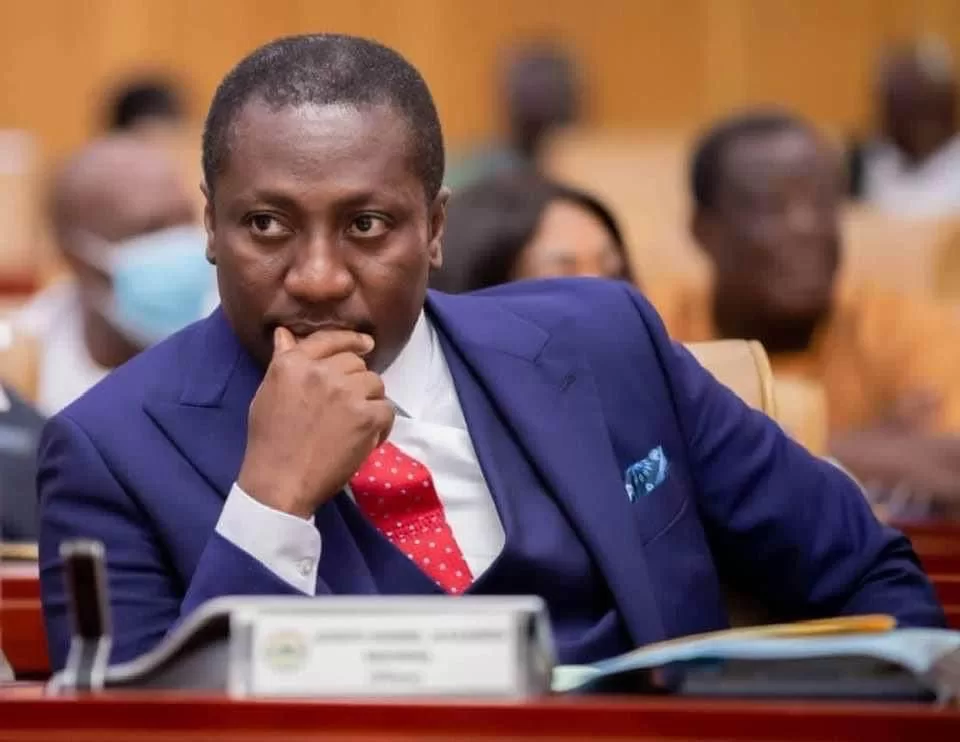
Minority Leader Alexander Afenyo-Markin has launched a blistering attack on the government of President John Dramani Mahama, accusing it of abusing executive power, undermining key state institutions and steering Ghana toward democratic backsliding.
Delivering his remarks at the end of Parliament’s Third Meeting on Friday, Afenyo-Markin warned that the country’s democratic foundations were being eroded from within and said public discontent had reached a dangerous level.
“Our nation is at risk,” he told the House. “What we are witnessing is an internal assault on our democracy.”
He accused the executive of marginalising Parliament and manipulating judicial processes to influence parliamentary representation, referring to unresolved constituency disputes in areas including Kpandai and Suhum.
“The cornerstone of democracy is simple,” he said. “Citizens elect their leaders—not judges and not state officials.”
The Minority Leader also claimed that there were attempts in some quarters to pave the way for a third presidential term, an allegation the government has consistently rejected.
“Any such agenda will be firmly resisted,” he declared. “This Minority will not allow it.”
Afenyo-Markin further criticised the frequent invocation of certificates of urgency to rush legislation through Parliament, describing the practice as a distortion of constitutional processes that weakens oversight and debate.
Turning to national tragedies, he accused the government of failing to enforce accountability. He referenced the deaths of six young women during a military recruitment exercise at the El-Wak Sports Stadium in Accra, as well as the fatal military helicopter crash in Obuasi that claimed eight lives, including two cabinet ministers.
“These were avoidable disasters,” he said. “Yet no one has been held responsible.”
On education, the Minority Leader argued that standards had declined under the current administration, citing what he described as the poorest WASSCE performance in seven years. He noted that more than 220,000 candidates reportedly failed core mathematics.
“Behind every statistic is a shattered future,” he said. “That is over 220,000 opportunities lost.”
He also raised concerns about youth unemployment, warning that the failure to deliver on the promised 24-hour economy posed serious economic and security risks.
Afenyo-Markin accused the government of double standards in its anti-corruption agenda, alleging selective prosecution and political bias. He cited moves to scrap the Office of the Special Prosecutor and claimed that opposition figures were pursued while allies of the governing party benefited from discontinued cases.
“Anti-corruption efforts must be impartial and credible,” he insisted.
He further criticised the now-abandoned lithium agreement, arguing that public resistance forced the government to reverse its position, and called for the resignation of Lands Minister Armah Kofi Buah.
On the economic front, the Minority Leader said rising prices, electricity tariff increases and inflation were deepening hardship for ordinary Ghanaians, accusing the government of profligate spending amid worsening living conditions.
He also described Ghana’s recent foreign policy stance as “irresponsible,” cautioning that strained relations with partners such as the United States and Israel could damage the country’s global reputation.
Despite the sharp tone of his address, Afenyo-Markin concluded by expressing appreciation to parliamentary staff and the media, extending Christmas goodwill to colleagues and reaffirming that President Mahama’s mandate would end in 2028.
“There will be no covert third term,” he said. “We will not watch in silence as this government unravels the democratic legacy built over generations.”

