
The government has ushered in a major overhaul of the Value Added Tax (VAT) system effective January 1, 2026, unveiling what it describes as sweeping relief measures designed to ease financial pressure on households and businesses across the country.
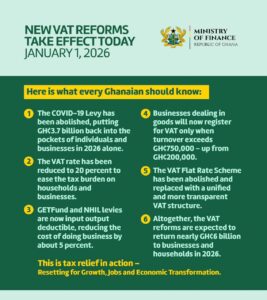
In a statement issued by the Ministry of Finance, authorities announced the complete scrapping of the COVID-19 Levy — a move projected to channel an estimated GH¢3.7 billion back into the pockets of citizens and enterprises within the 2026 fiscal year.
As part of the new package, the national VAT rate has been reviewed downward to 20 percent, a decision the government says will soften consumer spending pressures while supporting the growth of local industries. Additionally, the GETFund Levy and National Health Insurance Levy (NHIL) have now been made input-output deductible — a structural adjustment expected to slash operational costs for businesses by roughly five percent.
The revised framework also raises the threshold for compulsory VAT registration. Under the new regime, only businesses in the goods sector with annual turnover above GH¢750,000 will be required to register — a significant leap from the previous GH¢200,000 benchmark.
Another major shift under the reforms is the elimination of the VAT Flat Rate Scheme, which has now been replaced with what the government describes as a unified, fairer and more transparent VAT system.
Overall, authorities estimate that the new VAT measures will channel close to GH¢6 billion back into households and the productive sector in 2026. The reforms, according to the Ministry of Finance, form part of a broader national strategy to stabilise the economy, stimulate growth, support job creation and drive long-term economic transformation.